I didn't manage to keep an earlier promise to post olympiad-style problems... But here is a cute one.
You have n trees at given coordinates in the plane. You want to build a polygonal fence around the trees. However, the only way to get wood for the fence is to cut down some trees in the first place! Let's say each tree gives you enough wood for M meters of fence. The goal is to find the minimum k, such that you can cut down some k trees, and surround the rest by a fence of M*k meters.
What is the best algorithm you can find? Express your answer in terms on n and k.
As a bonus challenge, find a fast algorithm for the case when trees give you a different amount of wood M1, ..., Mi.
Tuesday, November 6, 2007
Cute Problem: Wooden Convex Hull

Monday, November 5, 2007
Napkins
The inexhaustible Muthu came up with the fantastic idea of assembling napkins used for research-related work. This could turn out to be very interesting.
Here is my own contribution: a Starbucks napkin filled during a 2 hour caffeinated discussion with Alex. It contains the proof of a communication-complexity lower bound for near-neighbor search in L∞, matching the current upper bound of Piotr from FOCS'98. We were working on this problem during our summer internship at IBM Almaden (yes, yes, we're officemates but we had to go to California to write a paper together). As you might expect, the fact that we're now trying to finish the details has some correlation with the Nov 19 fireworks party :)
Friday, November 2, 2007
A Numbers Game
I have said before that I believe theory/CS is a numbers game. During a few discussions sub vino, I was challenged on this issue. Two main points seemed to emerge:
- What matters is your best result (L∞).
- STOC/FOCS get 10-15 obvious accepts, and a heavy tail of competent papers, among which it's hard to choose. If we care about making STOC/FOCS a quality measure, why not accept just those 10-15 papers?
I have seen enough examples arguing for pessimism, mostly while I was acting as a reviewer. But since I can't actually talk about those, let me give 2 personal examples.
Predecessor. In STOC'06, Mikkel and I had our predecessor lower bound. The main claim to fame of this paper is that it was the first lower bound to separate linear and polynomial space.
When it comes to such a claim, in my opinion, it doesn't actually matter if you remember anything from the data structures class you took in college. It doesn't matter if you know that the bound is showing optimality of a very influential data structure from FOCS'75. It doesn't matter if you know this was one of the most well-studied problems in data-structure lower bounds, and people were actually betting the previous lower bound was tight.
No. Somebody comes and tells you that we've been toiling at this lower bound game for more than 20 years, and we haven't yet managed to show that a data structure with space n10 is sometimes better than one with space O(n). Now, they tell you, such a bound is finally here, and a vast array of problems from Algorithms 101 have switched from unapproachable to hopefully solvable. That should be a worthy result.
How did it feel from the inside? This was a paper we had worked on for 2 years. Just the conceptual understanding that we needed to develop felt like one of the longest journeys I have ever embarked on. And in the end, it was actually a clean result, which indeed needed conceptual developments, but not so much technical pain! Mikkel, who never ceases to amaze me with his youthful optimism, was betting on a best paper award. I was of course at a university, and had a better estimator of the community hype factor. I knew that Irit's PCP was unbeatable for an award, but I was still convinced our paper would go down with a splash.
The actual outcome? Moderately positive reviews. Nobody took notice. And we weren't even invited to the special issue, which was a genuine shock for us.
Range Counting. In STOC'07, I had a lower bound for 2D range counting. After the predecessor paper, I quickly decided this was the next big goal in the field. Range queries are very, very well-studied, play a crucial role in our understanding of data structures and geometry, and are a major bridge to worlds outside theory, such as databases (see this irrefutable argument). Armed with some appreciation of the techniques in the field, this also felt like a make-or-break problem: we were either going to solve it, or get stuck again for 20 years.
Though I like to look at cell-probe lower bounds, range counting has a life of its own. This class of problems was studied from the dawn of computer science, way before our understanding of models crystallized. People have been proving many excellent lower bounds for range queries in the so-called semigroup model: each input point is associated with weights from a semigroup; the goal is to compute the sum in a "range" (rectangle, circle, wizard's hat etc), using only the semigroup addition. In this model, we obtain a good understanding of geometry: it is enough to characterize a partial sum of a subset of points by the extreme points in a few directions. Addition only allows us to "build up" subsets, so we need to understand composability of constant-dimensional shapes, dictated by such extreme points.
While the bounds for semigroups were making very nice progress, we remained clueless about even the slightly stronger group model, where subtractions are allowed. This is the gap between understanding low-dimensional geometry and understanding computation (a very high-dimensional, unstructured space, such as the n-dimensional space of linear combinations). Proving bounds in the group model became the first lower-bound question in the surveys of Pankaj Agarwal and Jeff Erickson. Thus, the group model seemed hard enough; never mind the cell-probe model, which is significantly stronger than a model with additions and subtractions.
About a year after predecessor (I had the final critical insight one week before STOC), I managed to show an optimal lower bound for 2D range counting in the cell-probe and (of course) the group model. Again, it does not seem to me like a paper where you need to be an expert to understand that something interesting is happening. Citing from the abstract:
Proving such bounds in the group model has been regarded as an important challenge at least since [Fredman, JACM 1982] and [Chazelle, FOCS 1986].It seems to me that whenever somebody claims to address a challenge from JACM'82 and FOCS'86, the only possible answers are:
- You are lying.
- The paper is wrong.
- It seemed like an interesting problem back then, but things have changed and we no longer care. (... and I don't see this applying to range queries.)
- Yes, this is a very good paper.
Finally, the paper was not invited to the special issue. By this time, it was not something that had never crossed my mind; it was just a disappointment.
Conclusion. You should work on major open problems. If you solve them, it makes for papers which are reject-proof (well, almost). But don't count on that "one big result" plan, as you may be in for a nasty surprise. As a community, we are reliable enough to get some kind of average right, but we're not doing so well on L∞.
So when you get your first STOC/FOCS paper, go open the champagne or light up the cigar. You are officially part of the game. Now, it's time to play.
Next round: November 19.
Sunday, October 28, 2007
Rational Search
We all know the number guessing game. I think of an integer between 1 and n, and you try to guess it by comparison queries, "is it larger than x?". Binary search takes ceiling(log2 n) queries, which is of course optimal.
But what if I think of a rational number a/b , with 0<a<b<n? Can you still guess it with a few comparison queries? Take a few seconds to show that you can guess it with 2log2 n + O(1) queries, and that's optimal. (It's a 1-line proof.)
x
x
x
x
x
x
This space intentionally left blank.
x
x
x
x
x
x
Two fractions with denominators up to n cannot be closer than 1/n2. Thus, you binary search for k such that the number is in the interval [k/n2 , (k+1)/n2). This interval contains a single fraction, so you can just go through all fractions and find the one inside. On the lower-bound side, there are on the order of n2 fractions, so it takes at least 2log2 n - O(1) queries with binary output.
The moral of the story is, of course: be careful about the difference between actual running time and query complexity. But now let us show that you can actually find the unique fraction in the small interval with running time O(lg n). There are several papers doing this, including:
- Christos Papadimitriou, Efficient search for rationals, IPL 1979.
- Steven P. Reiss, Efficient search for rationals, IPL 1979
- Stephen Kwek and Kurt Mehlhorn, Optimal Search for Rationals, IPL 2003.
The really cool property of irreducible fractions is that if a/b and c/d are consecutive in some Farey sequence, then the "mediant" (a+b)/(c+d) is the first fraction that appears between them in a higher-order sequence. For example, the first fraction to appear between 1/2 and 2/3 will be 3/5.
With this property, we can construct the Stern-Brocot tree, which is an infinite tree exploring all fractions less than 1. The following picture from Wikipedia should explain everything:
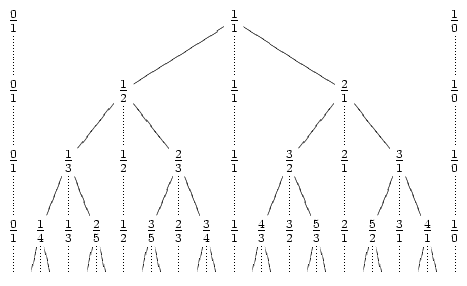 The intuitive algorithm is to go down this tree, looking for our fraction. Unfortunately, fractions with small denominators can appear very deep in the tree -- for example, 1/n is at depth n-1. Thus, we get O(n) time.
To improve this, we first show that the number of "turns" of the exploration is at most O(lg n). By turn, I mean switching from a going down on left children, to going down on right children (note that the 1/n example above had zero turns). Looking at the tree, it is easy to see that a turn essentially doubles denominators, so the property is easy to show.
Now we have to explore the straight descents efficiently. Let's say the fraction falls between a/b and c/d, and we take t steps to the left. This will land us at precisely (ta+b)/(tc+d). We can solve this equation for t, and find the minimum value which makes the fraction less than the target interval. Thus, we can calculate the number of consecutive left steps in constant time.
If we're too lazy to solve the equation, we can binary-search for t. Here we use galopping binary search, i.e. we take time O(lg t) to guess the unknown t.
Surprisingly, this will not give O(lg2n) time in total, but still takes O(lg n) time. This follows because the sum of the lg t values traces the number of times the denominator doubles, and it can only double O(lg n) times.
Overall, we have query complexity, Farey sequences, doubling arguments, galopping binary search, and summing up logarithms. This probably makes very nice material for an undergraduate "Math for CS" course.
(As a person who has never taken, nor taught such a course, I of course feel entitled to have opinions about it.)
Thursday, October 11, 2007
Range Queries (I)
I am now in Bonn, spending some time talking to Yakov Nekritch about range queries. Since this is a field I care about a lot, I will write a series of posts on it.
First, let me begin with my spiel on the importance of studying range queries. This is taken from the beginning of my talk at UW in May.
Once upon a time, you go to a bar in NY and you're trying to pick up a nice woman. She tells you she works in HR, and you tell her you are a theoretical computer scientist. She confesses she has not idea what that means, at which point you clarify "Oh, I am trying to understand the fundamental nature of computation". The blank stare you get is a clear indication that some more clarification is needed.
What do you then explain at this crucial moment of the night? Though I have not tried the following options myself, the prevailing opinion is that they are ill-advised:
- I am trying to prove lower bounds for constant depth circuits with mod-6 gates.
- I am trying to extract pure randomness from 2 independent sources with small min entropy.
- I am trying to design codes of subexponential size with efficient local decodability.
- I am trying to show that a diagonalization argument cannot separate P and NP, even if it is given a low degree extension of an oracle.
But here you're in luck. The gorgeous HR woman actually uses computers every day, and she knows exactly what they're supposed to do. Chances are, she even has some exposure to a programming language! That is of course SQL, which is very useful for her work. The only trouble is -- for her, and for most of the planet, computers are a great tool for data storage and manipulation, not a great tool for finding Hamiltonian paths.
So what do you tell her? Anybody who has attended 5 minutes of a SQL tutorial has seen examples like:
In fact, she probably runs code like this on a daily basis. Thus, she already understands orthogonal range queries -- formally, you are given a set of points, and you ask for points in some rectangle.SELECT * FROM employees
WHERE salary <= 70000 AND startdate <= 1998
You can now explain that your work is about how fast such queries can be executed, and, with her curiosity satisfied, move to more charming topics.
PS: This post is not about bad-mouthing complexity theory. For a long time, I have considered myself a complexity theorist, and I am interested in many topics in the field, well beyond my own research. The funny references are to some very particular young-and-eager complexity theorists, who have occasionally exasperated me with comments like "Yeap, data structures can be interesting sometimes, but really our goal is to understand computation". The point, if it was not clear enough, is that data structures are certainly not more artificial as our other computational questions -- maybe most computational questions that computer users care about are data-structure (database) questions.
Friday, October 5, 2007
Schedule
For the past two weeks, I have been enjoying the unique atmosphere of Romania. I promise to blog a bit about Romania and its universities next week, since most people are probably not aware of this parallel academic universe.
Now it is time to get back into the real world, and possibly do some work. Of course, on the way to doing work, I might as well have some fun. My upcoming schedule is as follows:
- Oct 6: Timisoara (my first visit to this reportedly beautiful city in West Romania)
- Oct 7: Budapest
- Oct 8: Bratislava (first time in Slovakia)
- Oct 9: Amsteram
- Oct 10 -- Oct 16: Bonn
I am visiting Yakov Nekritch, whose homepage picture reminds me of pre-1989 Romania (a mid-level Party administrator for agriculture, looking proud of his crops).
On Monday, Oct 15, at 10am, I am giving the following talk:
Dynamic Graph Algorithms invade Geometry
After dynamic graph algorithms has been an area of intense research in data structures for almost 30 years, the time seems ripe for the field to tackle problems of a geometric nature. In dynamic graph algorithms, we have a graph that is being changed through updates (typically edge insertions and deletions), and we want to query it for various graph properties (say, whether two nodes are connected, the cost of an MST, the shortest path between two nodes etc).
Now consider a scenario in which we have sensors distributed in the space, and each sensor can only talk to another sensor at radius r. The connectivity is defined by the intersection graph of discs of radius r/2 around every point. Can we handle a dynamic environment, e.g. a situation when new sensors can be inserted, or some sensors run
out of battery?
Our results apply to the intersection graphs of a very general class of objects (includings disks, segments, rectangles) and support the dynamic connectivity problem in time O(nc) per update and query, where c is a constant less than 1 depending on the geometric shape in question. This opens a very broad and promising research direction:- can new graph queries be supported (e.g. shortest path queries)?
- what is the best running time for each important geometric shape?
Joint work with Timothy Chan and Liam Roditty. - Oct 16 -- Oct 20: Brussels (first time in Belgium)
Here, I am visiting Stefan Langerman. On Thrusday, Oct 18 at 12:30, I am giving a talk:
Farey Sequences and Counting Primitive Lattice Points
A primitive lattice point is a point (x,y) with x, y integers and gcd(x,y)=1. "Counting" primitive lattice points inside various planar shapes has been an active area of mathematics in the past decades. But by virtue of seeking an elementary formula, the mathematical definition of "counting" is "approximating asymptotically". We now present the first results on the informatics view of this problem: give an efficient algorithm to count primitive lattice points exactly.
The problem is related to another entertaining mathematical problem that has crossed the border into informatics. The Farey sequence of order N is the sorted sequence of irreducible fractions a/b, with a≤b≤N. There are well-known algorithms for generating this sequence in its entirety. We now describe algorithms for finding just one value of the sequence (say the K-th value) significantly faster.
Joint work with Jakub Pawlewicz. - Oct 20 -- Oct 23: FOCS in Providence.
The talk is on Monday morning at 8:30, and I am giving it (Mikkel and I use the alternation principle for choosing the speaker). The paper is here.
Planning for Fast Connectivity Updates
Understanding how a single edge deletion can affect the connectivity of a graph amounts to finding the graph bridges. But when faced with d>1 deletions, can we establish as easily how the connectivity changes? When planning for an emergency, we want to understand the structure of our network ahead of time, and respond swiftly when an emergency actually happens.
We describe a linear-space representation of graphs which enables us to determine how a batch of edge updates can impact the graph. Given a set of d edge updates, in time O(d.polylgn) we can obtain the number of connected components, the size of each component, and a fast oracle for answering connectivity queries in the updated graph. The initial representation is polynomial-time constructible.
Tuesday, October 2, 2007
CRA Award
In 2005, I received CRA's Outstanding Undergraduate Award (my citation, with a nicely kempt picture).
I have been asked a bunch of times (most recently yesterday) for "insider" tips, my nomination materials, opinions etc. So why not post all of these publicly on the blog, to promote competition...
Here is the research statement and the CV that I submitted back then (2004). It's nice to see the CV has changed a bit since then, not only in the contact info section ;)
Below is some "advice" and personal opinions that I wrote in emails. But there is a catch that you must be aware of -- I certainly did not have a typical application. I had a bunch of research even back then, and I got the award based on work in my sophomore year, which is very very atypical. Thus, you can either think that (1) the application was good enough to earn me the award so early, so my advice is trustworthy; or (2) my circumstances were sufficiently weird that the application didn't really matter, so my advice is worthless.
For what it's worth it, here was the formula I used:
- I got the advice (maybe it was even official advice from CRA) to describe carefully what my contribution was on the papers, so I do that to some extent in the statement. At a later stage in life (post PhD), this would probably be unusual.
- I was also told that some contribution to humanity might not hurt, so the CV emphasized my involvement in organizing high school computer olympiads. Still I decided not to dramatize it too much.
- I did not mention intended future work, broader impact, and the like. My reasoning was that empty talk is a skill that senior researchers need to develop for grants. It is understood that empty talk is needed, so including it will not hurt your reputation.
But if young students write the kind of things we normally write in grants, they end up looking sily and childish. They should compete based on objective things they actually did, and get some respect based on objective criteria before the hype can begin.
Still, the fact that I did not speculate on future impact was probably the right thing to do. As I said already, I believe the tone of a statement at the student level should be strongly objective.
Subscribe to:
Posts (Atom)
![[home]](https://lh3.googleusercontent.com/blogger_img_proxy/AEn0k_tAj9Wmy9WuT8BkwHzgsMVxki8JYZd2zAeLWPYPtnH3fuFoerXT7IOgo4diwa6ZVovw9RphoHpDmXUSZaZSChR1bC_TDGEs3LFnq9BHgxGzhfQx=s0-d)


 Web views/day on average